
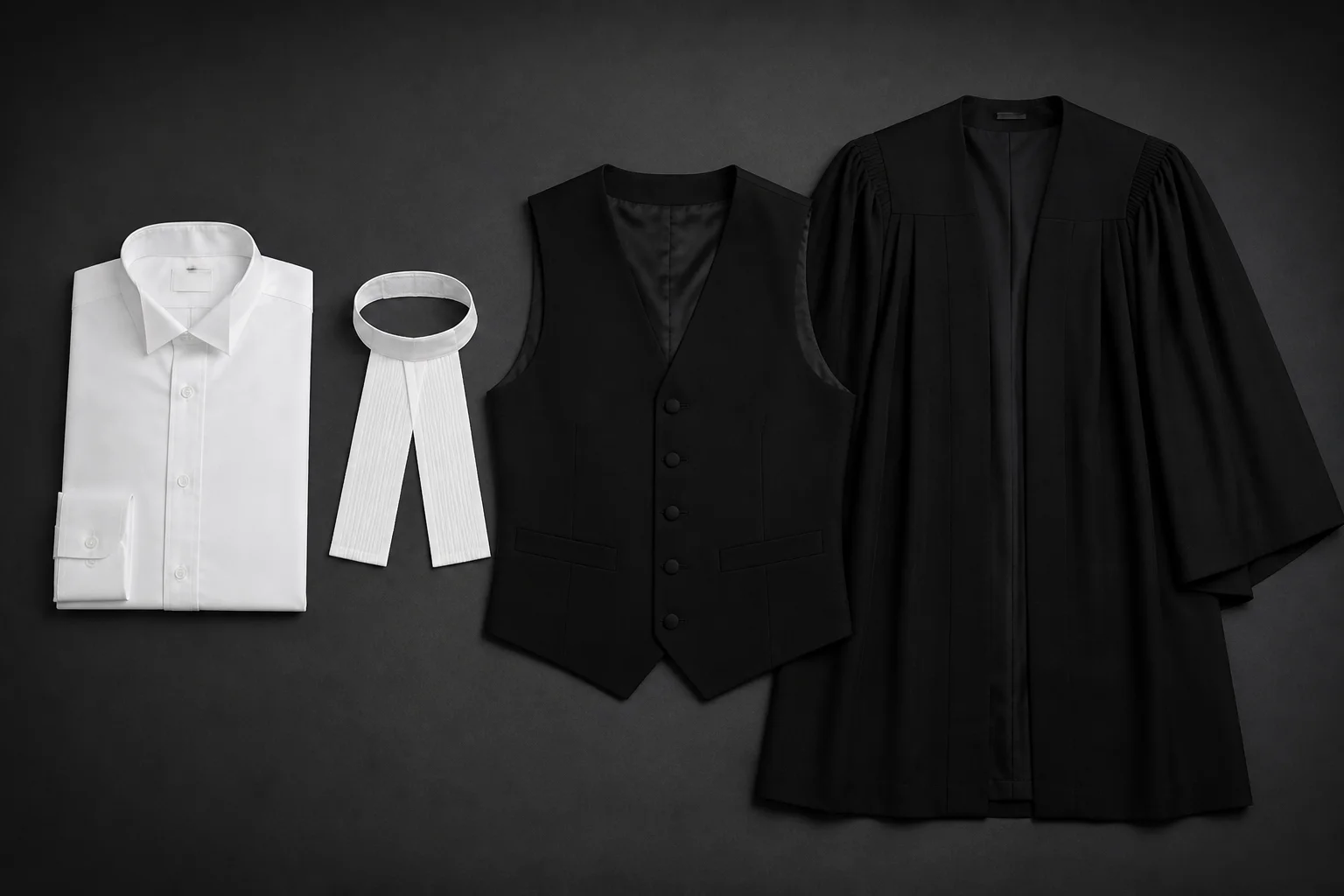
Nobody hands you a manual for this. If it’s your first time getting dressed for a call-to-bar ceremony or a court date, knowing how to wear barrister’s robes isn’t obvious. Which piece goes on first? How do the tabs actually attach? Are you even allowed to wear this yet? This guide answers all three, using the real construction of Barr’s robe and tabs, so the steps match what you’re actually holding.
Step-by-step: putting on your barrister robe
Court dress goes on in layers, from the collar outward. Getting the order right the first time saves you from redressing five minutes before you need to walk in.
- Start with your wing-collar shirt. Everything else in the outfit sits on top of this, so put it on and button it before touching any other piece.
- Attach your tabs at the collar (covered in detail below) before the waistcoat goes on, since the tabs sit closest to your neck.
- Put on your waistcoat over the shirt and tabs. It closes over the front, covering the top of your trousers or skirt and giving the tabs something to sit against.
- Put the robe on last, over everything. A barrister robe has an open front and full, wide sleeves, so it goes on more like a coat than a shirt. Push your arms through the sleeves first, then settle the yoke at your shoulders so the gathered fabric falls evenly on both sides.
- Check the back seam sits straight down your spine. This is what keeps the drape clean whether you’re standing at the bench or sitting through a long ceremony.
- Leave the front open. Barrister robes are worn open, not buttoned or fastened shut, so the waistcoat and tabs stay visible underneath.
What goes under all of this is largely up to your own workplace norms or your law society’s dress expectations. Most lawyers wear standard business attire, dark trousers or a skirt, dress shoes, beneath the shirt, waistcoat, and robe. The robe and tabs are what make the outfit distinctly court dress; everything under them is closer to ordinary professional clothing.
How to attach tabs
Barrister tabs are the two white pleated strips that sit folded down at the front of your collar, layered over the wing-collar shirt and under the waistcoat or robe. How they attach depends on which version you own.
- Traditional tabs tie on with cotton tape at the back of the neck. It works, but getting both sides even under time pressure takes practice, and a ceremony morning is a bad place to be fumbling with knots.
- Barr’s tabs use a Velcro closure instead. Fold the tabs down over your wing-collar shirt at the front of the neck. Bring the two ends around to the back and press the closure shut. You can do the whole thing yourself in a few seconds, without tying a knot or asking someone to check it’s even.
Either way, the front should look the same: two straight white strips, centered under your chin, level with each other. Check a mirror once they’re on. A closure that’s slightly off-center at the back can pull one tab lower than the other in front. If you don’t already own tabs, Barr’s barrister tabs use this Velcro closure and go on in seconds once they arrive.
Who can wear a barrister’s robe?
This is where a general guide like this one has to be honest about its limits. As a rule, robes and tabs are court dress for lawyers licensed to practice, and most people wear them for the first time at their own call-to-bar ceremony. After that, they’re worn for court appearances where they’re expected.
Exactly who must wear a robe and tabs is set by your own law society, not by a retailer’s guide. In Ontario, the Law Society of Ontario (LSO) publishes its own specific guidance on call-to-bar dress and court attire. Other provinces set their own requirements through their equivalent bodies. If you’re unsure whether a robe and tabs are expected for a specific appearance, check with your own province’s law society instead of relying on general information online. The details can vary by jurisdiction and by court.
Do you need a robe bag?
Not strictly, no. A barrister robe and tabs don’t need a dedicated bag to function. You can hang the robe in a closet and fold the tabs flat in a drawer between wears. Where a bag actually helps is protection during transport. A robe’s wide sleeves and gathered yoke are the parts most likely to crease if it’s stuffed into a regular suitcase or gym bag. Those creases in the woven polyester fabric take some ironing to work out before a court date.
If you’re traveling for a ceremony or a court appearance out of town, a garment bag helps. Pick one breathable and long enough to hang the robe without folding it in half. It doesn’t need to be made for court dress specifically. For everyday storage at home, a hanger keeps the robe in better shape than folding it. That matters more for how it looks on the day than any bag does.
FAQ
How do I put on barrister robes correctly?
Shirt first, then tabs at the collar, then the waistcoat, then the robe over everything, worn open rather than fastened shut. Settle the robe’s yoke at your shoulders and check the back seam sits straight before you walk out.
How do you wear tabs with a barrister’s robe?
Tabs sit folded down at the front of the collar, over the wing-collar shirt and under the waistcoat or robe. Barr’s version closes with Velcro at the back of the neck instead of the traditional tied cotton tape, so they go on in a few seconds.
What do you wear under a barrister’s robe?
The wing-collar shirt, tabs, and waistcoat go directly underneath. Below that, standard business attire, dark trousers or a skirt and dress shoes, covers the rest, following your own workplace or law society’s dress expectations.
Is a robe bag necessary?
No. It’s useful for keeping the robe crease-free during travel, but the robe and tabs work fine stored on a hanger and folded flat at home. Any garment bag long enough to hang the robe works; it doesn’t need to be purpose-made for court dress.
Ready to put the outfit together? Shop Barr’s barrister robes for the robe itself, or the barrister tabs if you still need Velcro-closure tabs to go with it.