
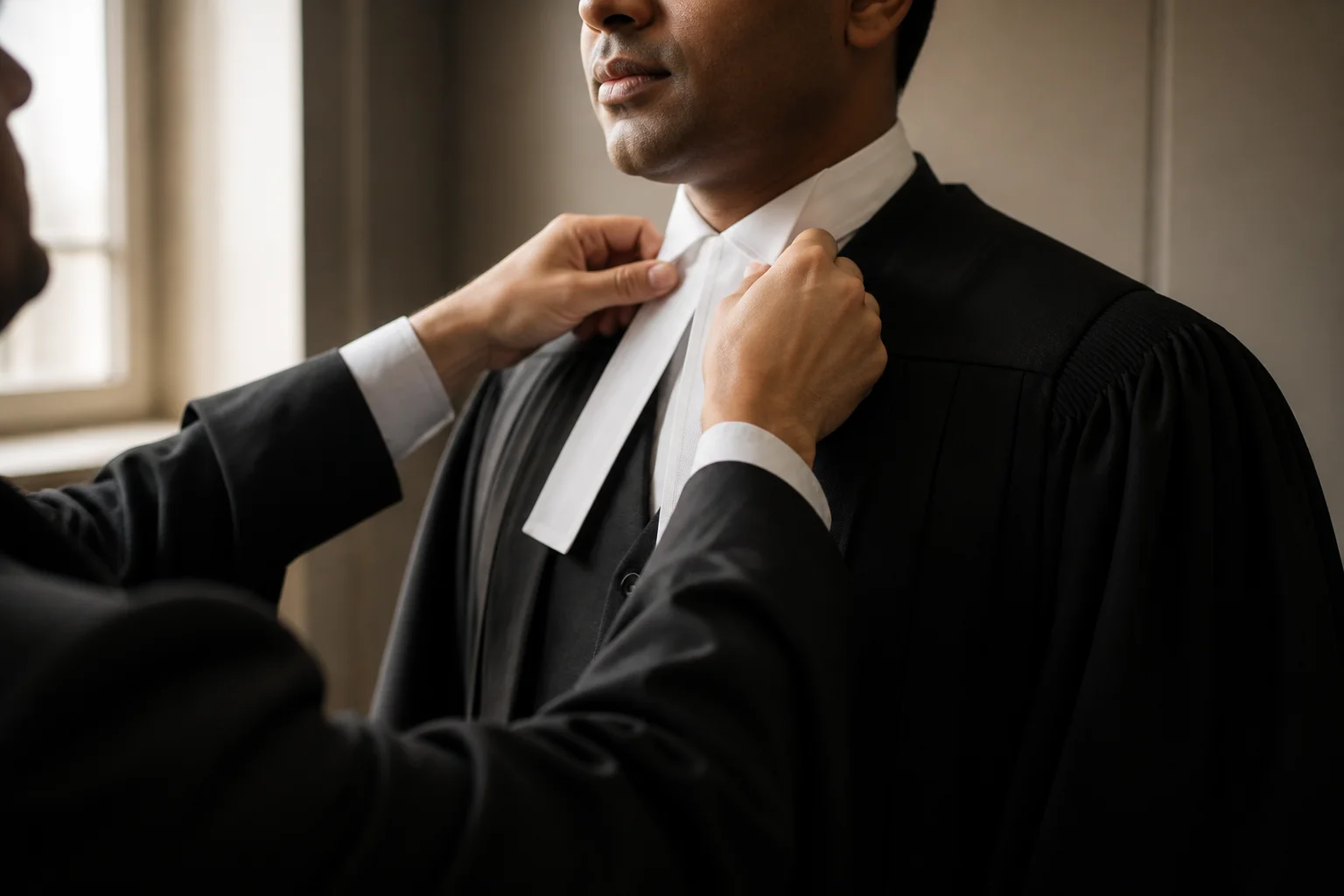
“Called to the bar” means a law graduate has met every legal requirement to practice law, and their law society has admitted them as a lawyer. In Canada, that makes someone a barrister and solicitor: licensed to give legal advice and appear in court. The call itself is a real event, not just a phrase. Candidates take an oath, sign the official roll, and are addressed by a judge or senior lawyer.
What Happens During the Call-to-Bar Process
Getting called to the bar is the last step in a path that starts years earlier. Here’s the usual order in Canada:
- Law degree. Most candidates finish an undergraduate degree first, then a three-year Juris Doctor (JD) or equivalent common-law degree.
- Licensing process. Each province’s law society sets its own requirements. Most combine courses, licensing exams, and a period of supervised work called articling. Articling usually runs 8 to 12 months, at a law firm, a government office, or another approved employer.
- Articling and exams. Candidates work under a licensed lawyer while studying for their licensing exams. Most of the practical training happens here: drafting documents, sitting in on client meetings, and learning how a real practice runs day to day.
- The call to the bar. Once a candidate clears the exams and finishes articling, their law society schedules the call. It’s usually a formal ceremony, with robing, an oath of office, and the signing of the roll of barristers and solicitors in front of a judge or bencher.
The specifics vary by province. Exam names, articling length, and ceremony format all differ, since each law society (the Law Society of Ontario, the Law Society of British Columbia, and so on) runs its own process. For the play-by-play of what the ceremony day itself looks like, see our call-to-bar ceremony guide. It covers the robing, the oath, and what to expect if you’re attending as a guest.
Who Gets Called to the Bar?
This is where a lot of confusion comes from, so it’s worth clearing up directly. In England and Wales, “barrister” and “solicitor” are two separate professions with two separate licensing paths. Only barristers are called to the bar there. Canada doesn’t split the profession that way.
A Canadian lawyer is licensed as both a barrister and a solicitor at once. It’s one title, one call to the bar. If you’re reading UK sources while researching a Canadian call, the terminology won’t line up.
So yes, Canadian solicitors are called to the bar, because Canada has no separate solicitor-only track. Everyone who completes the licensing process goes through the same call, no matter what kind of law they plan to practice.
Called to the Bar vs. Passing the Bar Exam
Passing the licensing (bar) exams is a requirement for being called to the bar, but the two aren’t the same thing. The exam confirms a candidate knows the material. The call to the bar is different: it’s the law society’s formal act of admission. It’s the point where a candidate becomes a licensed lawyer with the right to practice. You can pass every exam and still not be called yet. That usually happens because articling isn’t finished, or the next ceremony date hasn’t arrived.
There’s also a second, less-visible path worth knowing about: an administrative call. Lawyers who transfer their licence from another province, or who are reinstating a lapsed licence, are often called to the bar this way instead of through a ceremony. It carries the same legal standing, a full licence to practice. It just skips the robing and the public proceeding.
How Old Are Most People When They’re Called to the Bar?
There’s no fixed age, but the typical path points to a rough range. Add up a four-year undergraduate degree, a three-year law degree, and about a year of articling. Most candidates who go straight through are called somewhere in their mid-to-late twenties.
It’s just as common to see people called younger or older. Some go through an accelerated combined-degree program and finish sooner. Others come to law after a first career or graduate studies, or take a slower path through articling. The ceremony itself doesn’t check anyone’s age. It checks that the requirements are done.
FAQ
What does “called to the bar” mean, in one sentence?
It means a law society has formally licensed someone to practice law, after they’ve completed their degree, licensing exams, and articling.
What’s the difference between “call to the bar” and “call to bar”?
Nothing. They’re the same phrase. “Call to the bar” is the more common, grammatically complete form. “Call to bar” is a shortened version people use in casual speech and headlines.
When are you called to the bar?
Once your law society confirms you’ve completed articling and passed your licensing exams. Exact scheduling varies by province and by year, so check your law society’s own notice rather than a general date.
How do you get called to the bar?
Complete a qualifying law degree. Satisfy your provincial law society’s licensing requirements, including courses and exams. Finish articling. Then attend, or be granted, your call.
Is “called to the bar” the same everywhere?
The phrase is used across Canada, the UK, and other Commonwealth countries. What it requires differs by country. This guide covers the Canadian process specifically.
Can you be called to the bar without a ceremony?
Yes. That’s the administrative call described above, most often used for licence transfers and reinstatements.
What to Wear When You’re Called to the Bar
The call to the bar is a formal court proceeding, so the dress code isn’t optional. Most law societies expect a full barrister outfit for the ceremony: a black robe, a waistcoat, a wing-collar shirt, and white tabs at the collar.
Our dress code guide for the call-to-bar ceremony covers each piece in more detail. It shows how they fit together, and what to wear underneath the robe itself.